How to train for a 5K

A 5K is 5 kilometers, 3.1 miles. It’s the most popular race distance there is: short enough that almost anyone can train for one, and long enough to be a real test when you race it.

If you can only run for a few minutes at a time, the first goal is to run the whole way. That’s a run/walk plan: three sessions a week, the running a little longer and the walking a little shorter each time, until you run for 30 minutes without stopping. It takes nine weeks, and Pulsar never squeezes it.

If you already run, a faster 5K comes from a few things done every week: mostly easy running, one faster session, and a long run that stays short. For a 5K the most useful fast session is intervals at about race effort, because they rehearse the race itself.

Pulsar builds the plan from your answers: how long you can run without stopping, the days you can train and your latest 5K if you have one. It recommends at least six weeks for a newer runner and four for a trained one. With less time the plan gets tighter, and Pulsar tells you so.

Distance
3.1 miles (5 km)
Starting from zero
10 to 16 weeks
Recommended minimum
6 weeks, or 4 if you’re trained
Runs a week
2 to 7, you choose (up to 3 on run/walk)
Longest run
Up to 1 hour 15 minutes
Taper
1 week
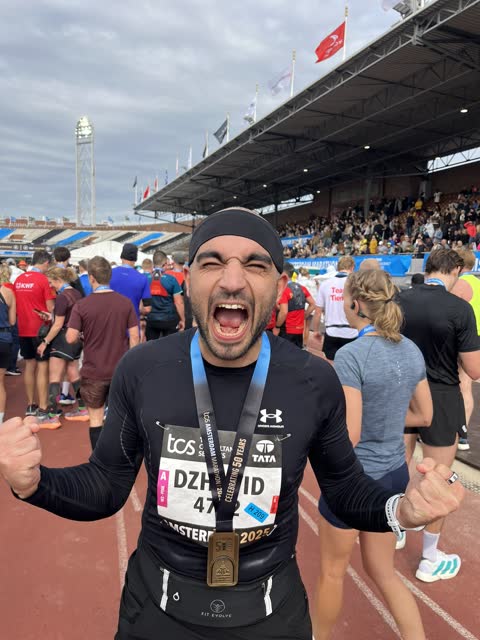
Dzhavid shouting in triumph on the running track of Amsterdam’s Olympic Stadium, a finisher’s medal round his neck.

I trained for three marathons alone. Pulsar is the coach I wish I’d had.

Dzhavid Kerimov · founder

Why a Pulsar 5K plan

Four things every Pulsar plan does for you, shown the way they look in the app.

  • Profile

    How long can you run without stopping?

    An honest answer sets the right starting point — there’s no wrong one.

    • I can’t run nonstop yetI take walk breaks to keep going
    • A few minutesUp to ~5 minutes before I walk
    • 10–20 minutesI can keep a steady jog going
    • 30 minutes or moreI can run continuously

    It starts where you are.

    Pulsar asks how long you can run without stopping, which days you can train and your latest race time, if you have one. Week 1 is built from those answers.

  • Easy run

    Aerobic Easy

    Week 7 · Tuesday Upcoming

    4.1 mi · ~45 min

    Coach’s insightTap to ask

    Keep your heart rate in Zone 1-2. You should be able to hold a conversation easily. If you’re breathing hard, slow down.

    Target heart rate

    Z1 RecoveryZ2 Aerobic123–148 bpm

    Structure

    Easymax 10:50 /mi

    4.1 mi

    Repeat ×4

    Strides7:55 /mi

    100 m

    Walk recovery

    1 min

    Every run is explained.

    Each run carries its distance, the pace to hold, the heart-rate zone to stay in and what it’s for, in plain words.

  • PULSAR Coach

    Why is my easy pace so slow?

    Because easy runs do a different job. They build your engine — heart, lungs, legs — without leaving you tired for Thursday’s 400s. If you can talk in full sentences, you’re right where you should be.

    AI-generated guidance, not medical advice. Talk to a doctor about health concerns.

    A coach that answers.

    After every run, a short note on what it meant, with your numbers. Between runs, ask about pace, fueling or a missed week.

  • The voice coach, in your earbuds: “Slow down, 20 seconds fast.”

    Guided on the run.

    Voice cues in your earbuds when a tempo or interval drifts off pace, and the whole workout on Apple Watch, with or without your phone.

Your 5K plan, week by week

Two runners, two 5K plans, both built by the app. Switch between them to see how the weeks change with the starting point.

  1. 6.1 Week 1, Base: 6.1 miles
  2. 6.2 Week 2, Base: 6.2 miles
  3. 5.4 Week 3, Base: 5.4 miles
  4. 6.9 Week 4, Build: 6.9 miles
  5. 6.8 Week 5, Build: 6.8 miles
  6. 7.7 Week 6, Build: 7.7 miles
  7. 8.0 Week 7, Build: 8.0 miles
  8. 8.8 Week 8, Build: 8.8 miles
  9. 9.3 Week 9, Peak: 9.3 miles
  10. 4.1 Week 10, race week: 4.1 miles of runs, then the 3.1-mile race
Weeks
10
Runs a week
3
Week 1
6.1 mi
Biggest week
9.3 mi week 9
Longest run
30 min nonstop, week 9

Built for someone who can’t run nonstop yet, three days a week: Tuesday, Thursday and Saturday. Miles per week as the app built them, race week without the 3.1-mile race; yours are built from your goal, your days and how you run today.

  • BaseEasy running and the habit first. From zero, this is run/walk.
  • BuildThe long run grows; faster sessions start.
  • PeakThe biggest week of the plan.
  • TaperLess running, same pace, fresh legs.
  • Lighter weekEvery fourth week, so your legs catch up.

How to get started

Four steps from here to the start line.

  1. Download Pulsar

    It’s free to download on iPhone. Your plan lives on the phone, and on Apple Watch if you wear one.

  2. Tell it your goal

    A race and its date, a distance, a time to beat, or running without stopping. Then how you run today.

  3. Run the plan

    Open today’s run and start it. Pulsar gives you the pace and the zone, and talks you through every segment.

  4. Reach the goal

    The plan builds week by week, then eases off before race day so you arrive fresh, not tired.

The workouts in a 5K plan

Every session has a job. These are real workouts from the two plans above, laid out the way the app shows them.

  • Run / Walk

    Run/Walk

    Week 1 · Tuesday

    2.0 mi · 29–32 min

    Structure

    Warm-up walkBrisk walk

    5 min

    Repeat ×8

    Runmax 13:00 /mi

    1 min

    WalkRecovery walk

    1 min 30 sec

    Cool-down walkBrisk walk

    5 min

    One minute of running and ninety seconds of walking, eight times, with a brisk walk before and after. Each week the running gets longer and the walking shorter.

  • Easy run

    Aerobic Easy

    Week 5 · Tuesday

    2.9 mi · 36–40 min

    Structure

    Easymax 11:25 /mi

    2.6 mi

    Repeat ×4

    Strides8:20 /mi

    100 m

    Walk recovery

    1 min

    Easy enough to talk the whole way, and most of your week. Four 100-meter pickups at the end keep your legs quick without making the run hard.

  • Intervals

    Fartlek Intro

    Week 3 · Tuesday

    3.7 mi · 41–46 min

    Structure

    Warm upmax 11:40 /mi

    1.2 mi

    Repeat ×4

    10K pace9:15 /mi

    400 m

    Walk recovery

    1 min 5 sec

    Cool downmax 11:40 /mi

    1.2 mi

    The first faster running in the plan, in week 3: four 400-meter pickups at 10K pace with a walk between each one.

  • Intervals

    800 Repeats

    Week 5 · Thursday

    3.7 mi · 40–44 min

    Structure

    Warm upmax 11:25 /mi

    1.2 mi

    Repeat ×2

    Threshold9:05 /mi

    800 m

    Walk recovery

    3 min 5 sec

    Cool downmax 11:25 /mi

    1.2 mi

    Your first interval sessions are run at tempo pace. You learn the shape of the session first; the speed comes a few weeks later.

  • Intervals

    Pyramid

    Week 6 · Thursday

    4.1 mi · 46–51 min

    Structure

    Warm upmax 11:25 /mi

    1.2 mi

    Threshold9:05 /mi

    300 m

    Walk recovery

    1 min 15 sec

    Threshold9:05 /mi

    400 m

    Walk recovery

    1 min 40 sec

    Threshold9:05 /mi

    500 m

    Walk recovery

    2 min 5 sec

    Threshold9:05 /mi

    400 m

    Walk recovery

    1 min 40 sec

    Threshold9:05 /mi

    300 m

    Cool downmax 11:25 /mi

    1.2 mi

    Up and back down: 300, 400, 500, 400 and 300 meters, each followed by a walk that grows and shrinks with the rep.

  • Intervals

    Cut-down 400s

    Week 7 · Thursday

    3.9 mi · 42–47 min

    Structure

    Warm upmax 11:15 /mi

    1.2 mi

    Rep 18:25 /mi

    400 m

    Walk recovery

    2 min 5 sec

    Rep 28:20 /mi

    400 m

    Walk recovery

    2 min 5 sec

    Rep 38:10 /mi

    400 m

    Walk recovery

    2 min

    Rep 48:10 /mi

    400 m

    Cool downmax 11:15 /mi

    1.2 mi

    Four 400s, each one a little quicker than the last. The walks between are almost as long as the reps, so each one starts fresh.

  • Long run

    Fast-Finish Long Run

    Week 5 · Sunday

    3.1 mi · 34–38 min

    Structure

    Easymax 11:25 /mi

    2.2 mi

    Fast finish — steady9:45 /mi

    0.9 mi

    An easy long run with the last stretch at a steady effort. It teaches you to run well when you’re already a little tired.

  • Easy run

    Shakeout Run

    Week 8 · Tuesday

    2.1 mi · 23–26 min

    Structure

    Easy runmax 11:10 /mi

    2.1 mi

    Race week: two short easy runs to stay loose. The work is done; this is about arriving fresh.

How long does it take to train for a 5K?

It depends on where you start. If your race date is too close for your starting point, Pulsar tells you before it builds anything and suggests a date or a target you can reach.

  1. Can’t run nonstop yet

    10 to 16 weeks

    Run/walk first. Nine weeks takes you to 30 minutes of running without a break, and the plan never cuts that short.

  2. Newer runner

    6 weeks or more

    Pulsar recommends at least six weeks if you run a little but not regularly.

  3. Trained runner

    4 weeks or more

    Four weeks is enough to sharpen. Eight gives you room to get properly faster.

Tips for your 5K training plan

What matters around the runs: what to eat, how to pace the race, how to recover. The coach in the app answers the rest.

Nutrition

A 5K doesn’t need special fueling. What helps is eating normally around your training: carbohydrates for energy, some protein at every meal for recovery, and water through the day.

  • Before a run: most people run well one to three hours after a light meal. Toast, a banana or oatmeal is plenty.
  • Early-morning easy runs are usually fine on an empty stomach. Before intervals, a small snack helps.
  • After a hard session: a meal or snack with carbohydrates and protein within a couple of hours.

Race morning: something familiar, about 300 to 500 calories, two to three hours before the start, low in fat and fiber. You don’t need gels or carb loading for a 5K. Nothing new on race day.

Strength and cross-training

Two short strength sessions a week are a good habit: squats, lunges, calf raises, hip bridges and a plank, about 20 minutes, on an easy day or a rest day. The research on strength training and injuries is mixed, so treat it as a useful extra rather than a requirement. Many runners find hills and the last half mile feel stronger for it.

Cross-training like cycling, swimming or the elliptical builds fitness without the pounding of running. Use it to stay active on a rest day or to add work without adding miles. Keep it easy the day before a hard run, so it doesn’t take anything out of the session that matters.

Pacing on race day

Most 5K runners, new and experienced, start too fast. Adrenaline makes the first half mile feel easy, and the last mile pays for it.

  1. Mile 1 Your goal pace, not faster. It should feel controlled, almost too easy.
  2. Mile 2 The hard part. Hold the pace; this is what the intervals were for.
  3. Mile 3 + 0.1 Start to push with half a mile to go, and give the last tenth everything.

Pick your pace from your training, not from hope: Pulsar predicts your race time from your runs, and that’s a good pace to start at. For a first 5K, run the first mile slower than you think you need to. There’s no “too slow” when the goal is the finish.

Form

Good running form is mostly about staying relaxed. A few cues that help most people:

  • Run tall and look ahead, not down at your feet.
  • Keep your shoulders low and loose, and your hands unclenched.
  • Take short, quick steps that land under your body rather than out in front.
  • Swing your arms forward and back, not across your chest.

Don’t try to fix everything at once. Take one cue into a run and practice it on your strides, where running fast feels most natural.

Recovery

Fitness is built between runs, not during them. In a 5K plan that means:

  • Sleep seven to nine hours. It’s when your body repairs.
  • Keep easy runs easy, and take the rest days the plan gives you.
  • Expect some muscle soreness in the first weeks. It fades as you adapt.
  • After a 5K race, a few easy days and you’re ready to train again.

If a pain is sharp, gets worse as you run, or changes the way you run, stop and see a doctor or a physical therapist. Pulsar’s coach will tell you the same: it isn’t a doctor, and it won’t guess.

Gear

A 5K needs very little:

  • Shoes that fit. Buy for fit, not brand; a running store can watch you run and help you choose. Pulsar can track the miles on each pair.
  • Clothes in a technical fabric that wicks sweat. Cotton gets heavy when it’s wet.
  • Your iPhone or Apple Watch. Pulsar tracks the run with GPS and talks you through it, and the watch can do it without the phone.

On race day, wear only what you’ve trained in. New shoes, new socks and new shorts can all wait until next week.


How a Pulsar plan is built

The rules every plan keeps. They’re the same rules the coach explains when you ask why.

  1. Mostly easy

    About four-fifths of your running is easy enough to talk through, and Pulsar leans more careful than that on purpose. Easy running builds the engine; the hard sessions only work on top of it.

  2. Every fourth week lighter

    Three weeks of building, then a lighter week at about 80 percent so your legs catch up. The week after picks up where the build left off, not beyond it.

  3. A little more each week

    Weekly mileage grows by about 7.5 percent for newer runners and 10 percent for trained ones, with a cap on any single jump. Hard days never land back to back.

  4. Paces from today’s fitness

    Your paces are worked out from your recent race or how you run now, never from your goal, and they move week by week as the plan goes on.

  5. Long runs have a time limit

    In a 5K plan the long run stops at 1 hour 15 minutes, however quickly you cover the ground. A 5K is won in the faster sessions, not in extra miles.

  6. Easier at the end

    The last week before the race cuts the miles by 30 to 40 percent and keeps the pace, so you start the 5K fresh.

FAQ: training for a 5K

How long is a 5K in miles?

A 5K is 5 kilometers, which is 3.1 miles.

How long does it take to train for a 5K?

From zero, about ten weeks: nine weeks of run/walk to 30 minutes of nonstop running, then the race. Pulsar builds those plans from 10 to 16 weeks. If you already run, six to eight weeks is typical, and four is the minimum Pulsar recommends for a trained runner.

Can I train for a 5K if I can’t run at all yet?

Yes. Tell Pulsar you can’t run nonstop yet and your plan starts with run/walk: one minute of running and ninety seconds of walking, eight times. By week nine you run for 30 minutes without a break.

What is a good 5K time for a beginner?

The one you finish. Plenty of people walk part of their first 5K, and nobody minds. Once you have a time, it becomes the starting point for the next one, and Pulsar can build a plan to beat it.

How many days a week should I run?

Three is a good start. Pulsar builds plans on 2 to 7 days a week, and a run/walk plan uses up to three, because that’s how the program is designed.

How do I run a faster 5K?

Keep most of your running easy, add one faster session a week, and keep it up for six to eight weeks. For a 5K that session is mostly intervals at about race effort, with some tempo runs. That’s the shape of every Pulsar 5K plan.

Do I need to run 5K before race day?

Not necessarily. A plan from zero builds to 30 minutes of nonstop running, which covers most of the distance. If you already run, your long runs will reach 3 miles or more. On the day, the crowd carries you the rest of the way.

I only have four weeks. Can I still train?

If you already run regularly, yes: four weeks is enough to sharpen. If you’re newer, Pulsar recommends six. With less time it builds a tighter plan and says so, and if the date is far too close it suggests a target you can reach instead.

What should I do after my first 5K?

Pick the next goal. A faster 5K is one option; a 10K is the natural next step, and Pulsar builds that plan from your new 5K time.

Name the goal. Get the plan.

Download PULSAR on the App Store

Free to download · iPhone and Apple Watch